Our Community

Faculty

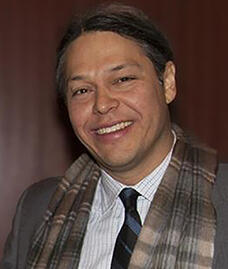
Tarren Andrews's picture
Assistant Professor of Ethnicity, Race, and Migration
Read moreRead less

Tarren Andrews is Assistant Professor in Ethnicity, Race, and Migration. She received her Ph.D. in English from the University of Colorado, Boulder. She has graduate certificates in Native American and Indigenous Studies; Culture, Language, and Social Practice; and College Teaching.

Her scholarship employs critical Indigenous studies to re-evaluate and re-narrativize stories of the early medieval North Atlantic (pre-1100). Her forthcoming book takes a transtemporal approach to law and literature, re-examining legal and literary artifacts from the early medieval North Atlantic—like the Domesday Book (England, ca. 1085), the Treaty of Alfred and Guthrum (England, ca. 878), and the Old English poem The Wife’s Lament (ca. 10th century)—alongside resonant documents and stories from Turtle Island (North America) including the Dawes Act of 1887, the Hellgate Treaty of 1859, and the Canadian Indian Act of 1876. This work seeks to find origins of Anglophone settler colonial logics as they are manifested in U.S. and Canadian settler law to better understand how we might imagine anticolonial futures.

She has an essay forthcoming in Exemplaria comparing medieval settler and Indigenous approaches to slipstream sci-fi writing. Titled “Harold and Custer on the Slipstream,” this essay argues for the inherent hope offered by Indigenous storytelling.

In addition to these projects, Dr. Andrews is also passionate about language revitalization and translation. She contributed the opening lines (ln. 1-12) in the 2021 translation of Beowulf by All. The citation for this “reservation translation” includes the Flathead Indian Reservation where Tarren grew up, which she credited as a co-author to honor the relationship between land and language.

Dr. Andrews is the assistant medieval editor for The Sundial, a public-facing publication venue hosted by the Arizona Center for Medieval and Renaissance Studies. She has taught at the University of Montana, Université Jean Jaures – Toulouse II, Salish Kootenai College, and the University of Colorado, Boulder.

 
Laura Barraclough's picture
Professor of American Studies
Read moreRead less

Professor Laura Barraclough (PhD, University of Southern California, 2006) is an interdisciplinary scholar of land, memory, identity, and inequality in the United States. Her work integrates theories and methods from history, geography, and comparative ethnic studies.

Much of Professor Barraclough’s research has focused on the U.S. West – how colonialism, racism, sexism, and class inequality are produced and challenged through the cultural politics of land-use. She is especially interested in the tension between the rural and the urban as a constitutive dimension of this process. Her first book, Making the San Fernando Valley: Rural Landscapes, Urban Development, and White Privilege (University of Georgia Press, 2011), shows how the intentional production of rural landscapes in Los Angeles since 1900 has been a vehicle for constructing settler colonialism and whiteness. Her second book, Charros: How Mexican Cowboys are Remapping Race and American Identity (University of California Press, 2019), looks at how Mexican Americans in a range of southwestern cities have used the figure of the charro for social justice, cultural citizenship, and place-making initiatives. Dr. Barraclough’s current research examines how Native communities and communities of color have used the National Historic Trail system, a public history program established by U.S. Congress in 1978, to disrupt white-settler narratives of American history and to tell their own stories.

A second strand of Professor Barraclough’s work seeks to make the insights of radical geography and ethnic studies accessible and useful to public audiences. She is co-author, with Laura Pulido and Wendy Cheng, of A People’s Guide to Los Angeles (University of California Press, 2012), an alternative tourist guidebook that highlights sites of racial, gender, sexual, labor, and environmental struggle in LA’s vernacular landscapes. A People’s Guide to LA received the Globe Award for Public Understanding of Geography from the Association of American Geographers and the Southern California Independent Bookseller Association Award for Non-Fiction. With Pulido and Cheng, she co-edits the People’s Guide book series with UC Press; guidebooks are forthcoming for New York City, the San Francisco Bay area, Boston, New Orleans, Orange County, and other cities. She has published in popular outlets including the Los Angeles Times, Atlantic CityLab, and Pacific Standard, and she leads community workshops on social history and critical geography across the United States. She also sits on the editorial collective for Antipode: A Radical Journal of Geography.

Professor Barraclough teaches and advises students on urban history and policy; critical human geography; comparative ethnic studies; critical indigenous studies; and history and politics of the U.S. West. At Yale, she maintains affiliations with Ethnicity, Race, and Migration; Environmental Studies; and the Liman Center for Public Interest Law. Previously, she taught at Kalamazoo College, Antioch University Los Angeles, and California State University Fullerton.

Ned Blackhawk's picture
Professor of History and of American Studies
Read moreRead less

Ned Blackhawk (Western Shoshone) is a Professor of History and American Studies at Yale and was on the faculty from 1999 to 2009 at the University of Wisconsin, Madison. A graduate of McGill University, he holds graduate degrees in History from UCLA and the University of Washington and is the author of Violence over the Land: Indians and Empires in the early American West (Harvard, 2006), a study of the American Great Basin that garnered half a dozen professional prizes, including the Frederick Jackson Turner Prize from the Organization of American Historians.
 
In addition to serving in professional associations and on the editorial boards of American Quarterly and Ethnohistory, Professor Blackhawk has led the establishment of two fellowships, one for American Indian Students to attend the Western History Association’s annual conference, the other for doctoral students working on American Indian Studies dissertations at Yale named after Henry Roe Cloud (Winnebago, Class of 1910). He is also active in The Yale Group for the Study of Native America (YGSNA), an interdisciplinary working group interested in topics relating to Native America. 
 
Current Projects: The Rediscovery of America: American Indians and the Unmaking of U.S. History (Advanced Contract: Yale University Press, 2021)

Co-editor, with Ben Kiernan, Benjamin Madley, and Rebe Taylor, The Cambridge World History of Genocide (in 3 Vols. Cambridge University Press) Vol. II: Genocide in the Early Modern, Indigenous, and Imperial Worlds, from c.1535 to World War One (2021)

 
Michael Denning's picture
William R. Kenan, Jr. Professor of American Studies and of Ethnicity, Race, and Migration
Read moreRead less

Michael Denning is the author of Noise Uprising: The Audiopolitics of a World Musical Revolution (2015); Culture in the Age of Three Worlds (2004); The Cultural Front: The Laboring of American Culture in the Twentieth Century (1997); Mechanic Accents: Dime Novels and Working Class Culture in America (1987); and Cover Stories: Narrative and Ideology in the British Spy Thriller (1987). He is the coordinator of the Working Group on Globalization and Culture. His courses include reading and research seminars in cultural theory and twentieth-century cultural history.

Fatima El-Tayeb's picture
Chair (ER&M) and Professor of Ethnicity, Race & Migration and of Women’s, Gender, and Sexuality Studies
Read moreRead less

Fatima El-Tayeb is Professor of Ethnicity, Race & Migration and Women’s, Gender, and Sexuality Studies. Prior to arriving at Yale, she was a member of the departments of Literature and Ethnic Studies and director of Critical Gender Studies at the University of California, San Diego. She received her MA in American Studies and Modern European History and her PhD in History from the University of Hamburg, Germany. Her research interests include Black Europe, comparative diaspora studies, queer of color critique, critical Muslim studies, decolonial theory, transnational feminisms, visual culture studies, race and technology, and critical European studies.
 
She is the author of three books, Schwarze Deutsche. ‘Rasse’ und nationale Identität 1890 – 1933 (Campus Verlag, 2001), European Others: Queering Ethnicity in Postnational Europe (University of Minnesota Press, 2011) and Un/German. Racialized Otherness in Post-Cold War Europe (Cornell University Press 2025), and has co-edited a special issue on Time, Urgency, and Collaboration in the Corporate University for Feminist Formations. Her numerous articles and book chapters on the interactions of race, gender, sexuality, religion and nation seek to deconstruct structural racism in “colorblind” Europe and center strategies of resistance among racialized communities, especially those that politicize culture through an intersectional, queer practice. Her work has been translated into German, Spanish, Portuguese, Italian, Russian, and Danish. Her ongoing research projects explore the intersecting legacies of colonialism, fascism, and socialism in Europe and the potential of on transformative archives both in theory and practice.
 
El-Tayeb is founder of the Digital Archive of Black Europe and co-director of the Intersectional Black European Studies project. At Yale, she organizes the Race, Migration, and Coloniality in Europe Working Group. In addition to her academic work, she co-wrote (with Angelina Maccarone) the Black lesbian screwball comedy Alles wird gut/Everything Will be Fine (1997).
Zareena Grewal's picture
Associate Professor of American Studies and of Ethnicity, Race, and Migration and of Religious Studies
Read moreRead less

Zareena Grewal is a historical anthropologist and a documentary filmmaker whose research focuses on race, gender, religion, nationalism, and transnationalism across a wide spectrum of Muslim communities in the US and in the post-colonial Middle East and South Asia. Her first book Islam is a Foreign Country: American Muslims and the Global Crisis of Authority (NYU 2013) is an ethnography of transnational Muslim networks that link US mosques to Islamic movements in Egypt, Syria, and Jordan through debates about the reform of Islam.

Her first film, By the Dawn’s Early Light: Chris Jackson’s Journey to Islam, examines the racialization of Islam and the scrutiny of American Muslims’ patriotism long before September 11, 2001 and was nationally broadcast on the Documentary Channel.

Her second film for television, Swahili Fighting Words, is a collaboration with anthropologist Yunus Rafiq and traces the legacies of slavery, colonialism, and diasporic identity politics through poetry battles and Bongo Flava, a local genre of hip hop in Tanzania. 

Her new book project explores the issue of religious tolerance by tracing the range of meanings the Quran has for Americans in the context of the post 9-11 anti-Muslim political climate and the War on Terror. Americans’ positive and negative representations of the Quran loom large in contemporary debates about religious tolerance, in domestic debates about the limits of tolerance for religious minorities (Muslims) as well as debates about American global influence in which the US government aims to make Muslims abroad more tolerant.

Fadila Habchi's picture
Senior Lecturer and Senior Essay Coordinator in Ethnicity, Race, and Migration
Read moreRead less

Fadila Habchi is a lecturer in Ethnicity, Race and Migration. She received her B.A from the City College of New York and her Ph.D. in African American Studies and American Studies from Yale University.

Her research interests include the literature, culture, and history of the Caribbean and Europe. She examines the relationship between space, race, gender and literature, colonial history, postcolonial memory, and contemporary decolonial movements. She investigates memory projects of the Algerian war of liberation and of anti-slavery struggles in Martinique and France.

Her current book project, Inclusive Empire: Urban Imaginaries and the Poetics of Being in Postcolonial France, examines France’s institutional and discursive practices of (post)colonial governance couched in the rhetoric of national integration, gender equality, and international cooperation. She focuses on alliances between French women of North African descent and republican, liberal discourses. She analyzes these intimacies alongside the work of decolonial activists, artists, writers, and public intellectuals.

Before joining the faculty at Yale, she taught in the Women and Gender Studies department at Northern Arizona University. At Yale, she teaches the ER&M senior colloquium and courses on race and ethnicity in France, postcolonial and decolonial theory, Caribbean literature, and postcolonial urban thought.

Leigh-Anna Hidalgo's picture
Assistant Professor of Ethnicity, Race, and Migration
Read moreRead less

Leigh-Anna Hidalgo is Assistant Professor of Ethnicity, Race, and Migration. She received her PhD in Chicana/o and Central American Studies from University of California Los Angeles (UCLA). She is an interdisciplinary scholar whose scholarship integrates ethnographic methods, digital humanities, and Latinx geographies in analyzing contemporary urban labor struggles and resistance.

Her forthcoming book, Abolitionist Marketplaces (under contract with Duke University Press), is based on a seven-year visual ethnography with the leaders of the Los Angeles Street Vending Campaign (LASVC). This book puts forward a new theoretical framework for analyzing how informal workers living under legal forms of violence center radical consciousness, self-care, and community-care to collectively organize and transform the urban spaces and city policies where they live and work.

In addition, Hidalgo has an ongoing digital humanities project with the LASVC that draws on a visual research method she developed called augmented fotonovelas (photo-based comics) that utilizes augmented reality (AR) to merge ethnographic data with photography, audio, and video imagery so that multiple publics can “see” and “hear” aggrieved communities. Articles from these projects have recently been published in the Journal of Latino Studies and Latin American and Latinx Visual Culture. 

Peer-reviewed articles:

2022

“‘Show Them How They Treat Us’: Legal Violence Against Street Vendors,” Latino Studies. https://doi.org/10.1057/s41276-022-00367-2

2021

“The Love Story Against Displacement,” Latin American and Latinx Visual Culture. https://doi.org/10.1525/lavc.2021.3.2.11

Hiʻilei Hobart's picture
Director of Graduate Certificate Program (ER&M) and Associate Professor of Native and Indigenous Studies
Read moreRead less

Hiʻilei Julia Kawehipuaakahaopulani Hobart (Kanaka Maoli) is Associate Professor of Native and Indigenous Studies at Yale University. An interdisciplinary scholar, she researches and teaches on issues of settler colonialism, environment, and Indigenous sovereignty. Her first book, Cooling the Tropics: Ice, Indigeneity, and Hawaiian Refreshment (Duke University Press, 2022) is the recipient of the Native American and Indigenous Studies Association (NAISA) Best First Book Prize, the Scholars of Color First Book Award from Duke University Press, the Samuel and Ronnie Heyman Prize from the Yale University Faculty of Arts and Sciences (FAS), and received an honorable mention for the Lora Romero First Book Prize from the American Studies Association (ASA).

Hobart’s articles have appeared in refereed journals such as NAIS, American Quarterly, and Political Geography, among others. Her article “At Home on the Mauna: Ecological Violence and Fantasies of Terra Nullius on Maunakea’s Summit,” received the 2020 NAISA prize for “Most Thought-Provoking Article” in the field of Native and Indigenous Studies. She is the co-editor of the special issues “Radical Care,” for Social Text (2020) and “We are Not American, Still,” for American Quarterly (2024). Her second book project, Pleasure Seekers: Land, Power, and Colonial Parkspace, is under contract with Duke University Press. Short essays towards this project have been recently published in Parapraxis, The Avery Review, and Places Journal.

Professor Hobart holds a PhD in Food Studies from New York University, an MA in Studies in the Decorative Arts, Design, and Culture from the Bard Graduate Center, and an MLS in Rare Books Librarianship and Archives Management from the Pratt Institute. 

Nicholas Jones's picture
Professor of Spanish and Portuguese and of Ethnicity, Race, and Migration
Read moreRead less
Nicholas R. Jones, a Full Professor / Catedrático at Yale University, is the former King Juan Carlos I of Spain Center’s Scholar-in-Residence at New York University (2021-2022) and author of Cervantine Blackness (2024) and the multi-award-winning book Staging Habla de Negros (2019). A conceptual and theoretical thinker, Jones is a literary critic and cultural historian whose areas of expertise traverse the early African Diaspora and Black European Studies to Cervantes and Iberian Studies.
 
 
Grace Kao's picture
IBM Professor of Sociology and Professor of Ethnicity, Race, and Migration
Read moreRead less

Grace Kao is IBM Professor of Sociology and Professor of Ethnicity, Race, and Migration (Secondary appointment, by courtesy). She is also Faculty Director of Education Studies. She is also Director of the Center for Empirical Research on Stratification and Inequality (CERSI). 

She is Past Vice-President of the American Sociological Association. 

Professor Kao studies race, ethnicity, and immigration as they collectively relate to education and relationships among young people. She also has interests in the effects of migration on young people and has written papers on these topics in Mexico, China, and Spain. Currently, she is one of a team of researchers (led by Hyunjoon Park) that is examining the transition to adulthood among Korean Millennials. Professor Kao is also involved in the Longitudinal Study of the Dynamics of Social Life During COVID-19 (DSL-COVID). She is co-author of The Company We Keep: Interracial Friendships and Romantic Relationships from Adolescence to Adulthood (2019). More recently, she has developed interests in the Sociology of Music and K-Pop in particular. Her work has been published in the American Sociological Review, Annual Review of Sociology, Social Science Research, Social Science Quarterly, American Education Research Journal, Teachers College Record, Child Development, Early Childcare Research Quarterly, Population Research and Policy Review, Population and Development Review, among others. Her research has been supported by NICHD, The Spencer Foundation, The Russell Sage Foundation, and the Academy of Korean Studies.

Formerly, she was Professor of Sociology, Education, and Asian American Studies at the University of Pennsylvania, where she taught for 20 years. She is the Co-Editor (with Hyunjoon Park) of Research in the Sociology of Education. She has served on the Boards of the Population Association of America and the Association for Asian American Studies. In addition to serving as Past Vice-President of the American Sociological Association, she has served as Council member for the Sections of Asia/Asian America and Sociology of Education, and she has served as Chair of the Section of Children and Youth, and served on ASA’s Nominations Committee. She has also served or currently serves on the Editorial Boards of the American Sociological Review, NYU Press’ Series on Asian American Sociology, Social Science Quarterly, Social Science Research, Social Psychology Quarterly, Sociological Forum, Sociological Perspectives, Social Problems, and Socius. According to Google Scholar, her work has been cited over 11,000 times. 

Courses and Seminars

Undergraduate

  • SOCY 144A. Race, Ethnicity and Immigration
  • SOCY 081B. Race and Place in British New Wave, K-Pop, and Beyond

Graduate

  • SOCY 663. Sociology of Education


Education: 
Ph.D., Sociology, The University of Chicago, 1997
A.M., Sociology, The University of Chicago, 1992
A.B., University of California, Berkeley, Sociology and Oriental Languages (Chinese Literature), 1990
Areas of Interest: 
Race and Ethnicity; Immigrant Adaptation; Sociology of Education; Adolescence; Asian Americans
Albert Sergio Laguna's picture
Associate Professor of Ethnicity, Race, and Migration and of American Studies
Read moreRead less

Albert Sergio Laguna is Associate Professor of Ethnicity, Race & Migration and American Studies at Yale University.

His research and teaching interests include transnational Latinx literatures and cultures, comparative ethnic studies, performance studies, and popular culture studies. His work has appeared or is forthcoming in Latino Studies, The Journal of Latin American Cultural Studies, Latin American Research Review, Contemporary Literature, Cultural Critique, Diario de Cuba, The Miami Herald, The Washington Post, and on CNN.com.

His article, “Aquí Está Alvarez Guedes: Cuban Choteo and the Politics of Play,” won the 2012 Article Award from the Latina/o Studies Section of the Latin American Studies Association. An article on radio in Cuban Miami received “Honorable Mention” for the Jack Rosenbalm Prize from the American Humor Studies Association.

Laguna’s first book, Diversión: Play and Popular Culture in Cuban America, won the 2018 Robert K. Martin Prize for Best Book from the Canadian American Studies Association, the 2018 Peter C. Rollins Book Prize from the Northeast Popular/American Culture Association, and received “Honorable Mention” from the Latina/o Studies Section of the Latin American Studies Association in 2019.

An article from his current book project, “Edgardo Vega Yunqué and the Comedy of Race,” was awarded the L.S. Dembo Prize from Contemporary Literature for best article published in that journal in 2018. 

Ximena Lopez Carrillo's picture
Lecturer and Upper-level senior seminar coordinator in Ethnicity, Race, and Migration
Read moreRead less

Lecturer in Latinx Studies in the Program in Ethnicity, Race & Migration. Her teaching interests include the history of medicine and mental health, the construction race in the United States, migration, and the politics of health and disease.

Her current project examines the emergence of a Latinx mental health activism during the 1960s and 1970s as an attempt to correct the pseudoscientific theories associating Mexican Americans and Puerto Ricans with mental illness and criminality. By tracing the intellectual debates of psychiatrists and psychologists in Texas, California, and New York, she examines the role of mental health discourses in the construction of the Latinx identity and the inter-ethnic alliances between Mexican Americans and Puerto Ricans Her research was showcased in Nexos-(Dis)capacidades, a blog about mental health, disability, and health policies.

She has worked at the Stony Brook Center for Civic Justice to create the Academy of Civic Life, a humanities-focused pre-college program for underserved high school students on Long Island, New York. She coauthored the article “Los Pacientes del Manicomio La Castañeda y sus diagnósticos. Una historia de la clínica psiquiátrica en México, 1910-1968,” and contributed the chapter “La Psiquiatría Infantil en la Secretaría de Educación Pública y la Emergencia de la Educación Especial”to the edited volumen La Psiquiatría Más Allá de sus Fronteras. She has also written about the history of intellectual disability in Mexico.

B.A in History at Universidad Nacional Autónoma de México

M.A in History at Stony Brook University

Doctoral Candidate in History at Stony Brook University

Lisa Lowe's picture
Samuel Knight Professor of American Studies and Professor of Ethnicity, Race, and Migration
Read moreRead less

Lisa Lowe received her B.A. in History from Stanford University, and her Ph.D. in Literature from University of California, Santa Cruz. An interdisciplinary scholar whose work is concerned with the analysis of race, immigration, capitalism, and colonialism, she is the author of Critical Terrains: French and British Orientalisms (Cornell University Press, 1991), Immigrant Acts: On Asian American Cultural Politics (Duke University Press, 1996), and The Intimacies of Four Continents (Duke University Press, 2015), and the co-editor of The Politics of Culture in the Shadow of Capital (Duke University Press, 1997) and New Questions, New Formations: Asian American Studies, a special issue of positions: east asia cultures critique 5:2 (Fall 1997). Before joining Yale, Lowe taught at the University of California, San Diego and Tufts University. Her research has been supported by fellowships from the Guggenheim, Rockefeller, and Mellon Foundations, the School of Advanced Study at the University of London, the UC Humanities Research Institute, and the American Council of Learned Societies.

Her recent publications include: “Reckoning Nation and Empire,” in Blackwell Companion to American Studies, J. C. Rowe, ed. (Blackwell, 2010); “New Worlds ‘Discover’ Asia,” American Quarterly, Vol. 68, Issue 2 (June 2016): 413-427; “History Hesitant,” Social Text 125, Vol. 33, No. 4 (December 2015): 85-107; “Transpacific Entanglements,” with Yen Le Espiritu and Lisa Yoneyama, in Flashpoints for Asian American Studies, C. Schlund-Vials, ed. (Fordham University Press, 2017); “Comparative Global Humanities After Man: Alternatives to the Coloniality of Knowledge,” with Kris Manjapra, in Theory, Culture & Society 36: 5 (September 2019); “Globalization,” in Keywords for American Cultural Studies, 3rd ed., B. Burgett and G. Hendler, eds. (NYU Press, 2019); and “Revolutionary Feminisms in a Time of Monsters,” in Revolutionary Feminisms, B. Bhandar and R. Ziadah, eds. (Verso, 2020).

Lowe’s teaching interests include the study of race and liberalism, immigration and U.S. empire, colonial domesticity and social reproduction, and cultures of globalization.

Mary Ting Yi Lui's picture
Professor of American Studies and of History, and of Ethnicity, Race & Migration
Read moreRead less

Professor Mary Ting Yi Lui is Professor of American Studies and History. Her research and teaching focuses on Asian American history, urban history, women and gender studies, and public history.

Her first book, The Chinatown Trunk Mystery: Murder, Miscegenation, and Other Dangerous Encounters in Turn-of-the-Century New York City, was awarded a 2007 best book prize for history from the Association of Asian American Studies. She recently appeared in a documentary film on the history of Chinese Exclusion Act directed by acclaimed filmmakers Ric Burns and Li-Shin Yu that aired on PBS’s American Experience in May 2018. She is currently working on a new book titled, Making Model Minorities: Asian Americans, Race, and Citizenship in Cold War America at Home and Abroad, that examines the history of Asian American and U.S. cultural diplomacy in Asia in the early years of the Cold War.

Professor Lui is Head of Timoth Dwight College. Before coming to Yale, she held appointments at the Chicago History Museum (as public historian), at Williams College (as the Charles Gaius Bolin Fellow and seminar instructor in history), and at the Museum of Chinese in the Americas (as a curator).

Gana Ndiaye's picture
Assistant Professor of Ethnicity, Race, and Migration
Read moreRead less

Gana Ndiaye is Assistant Professor of Ethnicity, Race, and Migration. He received his PhD from the Department of Anthropology at Boston University. He is an ethnographer with previous training in intercultural mediation and literature. His interdisciplinary research and teaching interests include migration, race and ethnicity, informal economies, Muslim market ethics, and the ʿAjamī (modified Arabic script) literary traditions of Muslim Africa. Dr. Ndiaye’s scholarship includes translation and digital humanities. He has been a key contributor to the National Endowment for the Humanities Ajami Project based at Boston University.

He also wrote and directed a Portuguese-language documentary on Senegalese migrants in Brazil: Senegaleses no Brasil: para além da economia informal (Senegalese Immigrant Lives in Brazil: Beyond Street Vending). Spanning West Africa and the Americas through multi-sited and multilingual ethnographic and archival research, his scholarship bridges the worlds of global Black migrations and Islam in Africa and the Americas. His current book project examines how Senegalese Sufi immigrants in Brazil strive to live ethical lives under capitalism. His work has appeared in peer-reviewed journals such as Islamic Africa, The Stichproben – Vienna Journal of African Studies, and in edited volumes on Islam in Africa and on stereotypes and migration.
 
Before joining the faculty at Yale, Dr. Ndiaye was Assistant Professor of Anthropology at Beloit College, Wisconsin.
Stephen Pitti's picture
Professor of History and of American Studies and of Ethnicity, Race, and Migration; Director, Center for the Study of Race, Indigeneity and Transnational Migration
Read moreRead less

Stephen Pitti is a Professor of History, American Studies, and Ethnicity, Race, and Migration at Yale University. He is also the Founding Director of the Yale Center for the Study of Race, Indigeneity, and Transnational Migration.

He is the author of The Devil in Silicon Valley: Race, Mexican Americans, and Northern California (2003), American Latinos and the Making of the United States (2012), and articles on Latinx history and historiography. He has provided expert reports on the history of racial animus for federal civil rights cases, and he is currently writing a book entitled The World of César Chávez. Appointed a Distinguished Lecturer by the Organization of American Historians and a Visiting Senior Fellow at the Andrew W. Mellon Foundation, he has delivered the Américo Paredes Distinguished Lecture at the University of Texas and keynoted the Latinos/as in Historic Preservation National Conference. He co-edits the “Politics and Culture in Modern America” series for the University of Pennsylvania Press and serves on the editorial board for the journal California History. At Yale he has organized or co-organized conferences and academic gatherings focusing on Mexican Music and Social Justice; Racism and the Radical Right in Europe and the United States; Japanese American Wartime Incarceration; and New Directions in Ethnic Studies.

As a past member of the National Park Service Advisory Board and chair of the National Historic Landmarks Committee, Professor Pitti led an effort to identify, preserve, and interpret historic sites that capture a broad and more accurate history of the United States. He has taught courses about the Smithsonian and is a member of the Advisory Board of the Yale-Smithsonian Initiative. He has chaired Yale’s Faculty Advisory and Selection Committee for the Mellon-Mays and Bouchet Fellowships since 2006. He has worked as a reviewer for the American Council of Learned Societies and other foundations, and he has chaired postdoctoral selection committees designed to support scholars in Ethnic Studies and related fields. He is a past member of the Faculty Advisory Committee on Athletics, the Board of Directors of Freedom University in Atlanta, the Steering Committee of the McDougal Center in the Yale Graduate School, the Advisory Board for the Bracero History Project at the National Museum of American History, the Yale-NUS College Advisory Committee, the Yale University Budget Committee, the Standing Committee on Yale College Expansion, the Faculty Advisory Committee of the Yale-New Haven Teachers Institute, the Yale Creative and Performing Arts Committee, the University Committee to Establish Principles on Renaming (in the aftermath of the Charleston massacre), and the Steering Committee for Yale College.

Professor Pitti received a B.A. from Yale College and both an M.A. and Ph.D. from Stanford University. He has been a President’s Postdoctoral Fellow at the University of California, San Diego and a Visiting Scholar at the Julian Samora Research Institute at Michigan State University.

Ana Ramos-Zayas's picture
Frederick Clifford Ford Professor of Ethnicity, Race, and Migration and Professor of American Studies and of Anthropology
Read moreRead less

Ana Y. Ramos-Zayas is the Frederick Clifford Ford Chair in Ethnicity, Race, and Migration.  She received her BA in Economics and Latin American Studies from Yale College, and her MA/PhD in Anthropology from Columbia University. She is the author of National Performances: Class, Race, and Space in Puerto Rican Chicago (The University of Chicago Press, 2003; ASA Latino Studies Book Award, 2006) and Street Therapists: Affect, Race, and Neoliberal Personhood in Latino Newark (The University of Chicago Press, 2012; Frank Bonilla Book Award 2010-12).

Her most recent book, Parenting Empires:  Class, Whiteness, and the Moral Economy of Privilege in Latin America (Duke University Press, 2020) examines the parenting practices of Brazilian and Puerto Rican upper classes, as these alter urban landscapes; provide moral justifications for segregation, surveillance, and foreign interventions; and recast idioms of crisis, corruption, and austerity to align with U.S. empire.

 Ramos-Zayas is also co-author of Latino Crossings: Mexicans, Puerto Ricans, and the Politics of Race and Citizenship (Routledge, 2003); co-editor of Critical Dialogues in Latinx Studies (NYU Press, 2022); and co-editor of Whiteness in Latin America and the Caribbean (LACES, Latin American Studies Association, 2023).  

Ramos-Zayas has published journal articles in the fields of youth culture, race, citizenship and migration, the anthropology of emotion and affect, therapeutic cultures,  and Latin American and Caribbean elites.  Prior to joining Yale in 2017, Ramos-Zayas conducted post-doctoral work in Educational Evaluation Research at Harvard; taught at Rutgers University-New Brunswick; and occupied the Valentin Lizana y Parragué Endowed Chair at the City University of New York. 

Ramos-Zayas’ ethnographic work examines systems of power and cultures of privilege at various scales in the Americas. Issues of social justice and the intersection of intimate worlds and political economic structures are fundamental concerns in her research.  Ramos-Zayas’ book-in-progress, tentatively titled Shrinking Wealth:  Psychoanalyzing the Brazilian Elite, focuses on the lives of a handful of individuals who unusual influence and access to the very wealthy in Sao Paulo: their psychoanalysts.

Books:

Parenting Empires:  Class, Whiteness, and the Moral Economy of Privilege in Latin America.  Duke University Press, April 2020  

Street Therapists:  Race, Affect, and Neoliberal Personhood in Latino Newark.  The University of Chicago press, 2012.

National Performances: Class, Race, and Space in Puerto Rican Chicago.  The University of Chicago Press, 2003.

Latino Crossings: Mexicans, Puerto Ricans, and the Politics of Race and Citizenship (co-authored).  Routledge, 2003.

Critical Dialogues in Latinx Studies A Reader (co-edited). NYU Press, 2021.

[Spanish Translation:  Crianza de imperios:  Clase, blanquitud y la economía moral del privilegio en América Latina.  CLACSO, 2022.  https://www.scribd.com/document/672718145/Crianza-Imperio]

Recent Publications Include:

-Disrupting the social by centering the self: Life coaching and the politics of marriage, motherhood, and adult sociability among Latinx and Latin American women. Ethos (2025): e70007.

-Forging a psychological solidarity: from the community mental health movement to Latinx life coaching in the South Bronx. Latino Studies 22, no. 2 (2024): 277-297.

-(co-authored). A conceptual roadmap for the study of whiteness in Latin America.” Latin American and Caribbean Ethnic Studies 18, no. 2 (2023): 177-199.

-Borders, Terror, and Puerto Rican” Delinquent Citizenship. American Quarterly 74, no. 3 (2022): 777-782.

Ramos-Zayas, Ana. “Therapeutic cultures in elite families in Brazil.” European Review of Latin American and Caribbean Studies/Revista Europea de Estudios Latinoamericanos y del Caribe 115 (2023): 25-42.

-Ordinary Whiteness: Affect, Kinship, and the Moral Economy of Privilege. (2021): 459-464.

-Wealth studies, whiteness, and family dynasties in Latin America: Preliminary reflections. In Wealth, Development, and Social Inequalities in Latin America, pp. 174-190. Routledge, 2023.

-Choosing schools, choosing (adult) friendships: National language, progressive self-fashioning, and social envy among Brazilian and Puerto Rican elites. economic sociology. perspectives and conversations 25, no. 1 (2023): 36-46.

–Parentalidade soberana” em bairros afluentes da América Latina: raça e a geopolítica dos cuidados com crianças em Ipanema (RJ) e El Condado (Porto Rico).  Revista de CiênciasSociais. Fortaleza, v. 48, n. 2, p.137-184, jul./dez., 2017

–(co-authored). Racializing Affect: A Theoretical Proposition. Current Anthropology. Featured/Anchor Article for the Journal Issue, Volume 56, no. 5, October, 2015, pp.654-677.

–Learning Affect, Embodying Race. Transforming Anthropology, Volume 19, Issue 2, October 2011, pp. 86-104.

– Urban Erotics and Racial Affect in a Neoliberal “Racial Democracy”: Brazilian and Puerto Rican Youth in Newark, New Jersey. Identities, Volume 16, Issue 5, 2009, pp. 513-47.

–Delinquent Citizenship, National Performances: Racialization, Surveillance, and the Politics of ‘‘Worthiness’’ in Puerto Rican Chicago

Alicia Schmidt Camacho's picture
Professor of Ethnicity, Race, and Migration
Read moreRead less

Alicia Schmidt Camacho is a Professor of Ethnicity, Race, and Migration, and holds affiliations with the Yale Center for the Study of Race, Indigeneity, and Transnational Migration, the Council of Latin American and Iberian Studies, and the American Studies and Women’s, Gender, and Sexuality Programs. Her scholarship examines migration, social movements, and cultural politics in North America. She has written articles about transnational labor organizing, gender violence and feminicide in Mexico, border governance, and migrant expressive culture.
 
Her book, Migrant Imaginaries: Latino Cultural Politics in the U.S.-Mexico Borderlands (NYU 2008), received the Lora Romero First Book Prize in American Studies. She is currently writing a second book for NYU Press entitled The Carceral Border, a study of the ways unauthorized migrants have confronted state and social violence along their passage through the North American migratory circuit since the 1980s. Another book project, derived from the 2019 Tam Tran Lectures in American Studies at Brown University and entitled Migrant Justice, considers the significance of defending human mobility in the contemporary era of mass deportation and border construction. This project takes up the examples of marronage and other historic contestations to sovereign power to theorize how migrants cultivate freedom within and apart from nation-states.
 
Her courses examine the histories of race making, colonialism, and slavery in North America; migration and border governance; and the formation of transnational Latinx communities in the U.S. 
 
In 2017, Professor Camacho formed the Migrant Justice Initiative, a multidisciplinary project for scholars to document and engage with migrant-led organizing, and to shape better understandings of migrant realities in the Americas. Partners have included the Global Labor Justice Project and the National Day Laborer Organizing Network.
 
A longtime resident of New Haven, she contributes to local organizations involved in labor, civil, and immigrant rights, including, most recently, Junta for Progressive Action, Inc., and the Connecticut Bail Fund. Professor Camacho works with feminist and political advocacy organizations in the U.S. and Mexico to address the concerns of migrants and other vulnerable transborder populations.


Quan T. Tran's picture
Senior Lecturer and Senior Essay Coordinator in Ethnicity ,Race, and Migration
Read moreRead less

Quan T. Tran is a senior lecturer in Ethnicity, Race, and Migration and American Studies and ER&M’s Upper-level senior seminar coordinator. She earned her PhD in American Studies from Yale University.

Deb Vargas's picture
Director of Undergraduate Studies (ER&M) and Professor of Ethnicity, Race, and Migration and of Women’s, Gender, and Sexuality Studies
Read moreRead less
Deborah R. Vargas is Professor jointly appointed in the Programs in Ethnicity, Race, and Migration and Women’s, Gender, and Sexuality Studies at Yale University. Vargas is also faculty affiliate with the Program in American Studies and the Council on Latin American and Iberian Studies.
 
As an interdisciplinary scholar, Vargas’ work engages the fields of queer studies, feminist studies, Chicana/e Latina/e Studies, and American Studies with an emphasis on the cultural politics of the U.S.-Mexico borderlands. Vargas is the author of Dissonant Divas in Chicana Music: The Limits of La Onda, awarded Best Book in Chicana/o Studies, The Woody Guthrie Prize for Best Book in Popular Music Studies and honorable mention for Outstanding Book in Latino Studies, Latin American Studies Association. Vargas is co-editor with Nancy Raquel Mirabal and Lawrence La Fountain-Stokes of Keywords for Latina/o Studies (New York University Press).
 
Vargas is also the author of Down and Dirty: Toward a Sucialogy of Queer Chicane Life (Duke University Press) that explores queer Chicana/e working-class aesthetics, vernaculars, and social spaces ranging from photographic series by Xandra Ybarra and Star Montana, cantina bars, and the varrio figures of the ruca, torcida, and hyna. Sucias are those who cultivate methods of refusal to the politics of respectability and propriety within racial capitalism and normative projects of “American” and “Latino” citizenship to sustain queer life forces.
 
Vargas’ other current research projects include: “Frequencies of Brown Soul,” that considers singers such as Freddy Fender, Black and Mexican recording sessions in San Antonio and Dallas, as well as contemporary Chicane soul bands such as The Sinseers and The Suffers. Vargas is also researching the life and music of singer Linda Ronstadt.
 
Vargas has conducted oral histories with Chicana singers for the Smithsonian Institute’s Latino Music Oral History Program and written for National Public Radio’s “Turning the Tables” music series. Vargas has been awarded fellowships from The UCLA Chicano Studies Research Center, The University of California Humanities Research Institute, The Ford Foundation and The Institute for Advanced Study, School of Social Science. Vargas received her B.S. in Communications and B.A. in Ethnic Studies from the University of Texas, Austin and her Ph.D. in Sociology (Feminist Studies certificate) from the University of California, Santa Cruz.
 

Affiliated Faculty

Sunny Xiang's picture
Associate Professor Tenure of English
Read moreRead less

Sunny Xiang studies and teaches race, war, and empire through wide-ranging aesthetic, cultural, literary, and documentary materials. Her work focuses on the methodological questions and perceptual challenges introduced by U.S. military empire in Asia and the Pacific during the mid-twentieth century.

Her first book, Tonal Intelligence: The Aesthetics of Asian Inscrutability During the Long Cold War (Columbia University Press, 2020), traces the visual and narrative crux of Oriental inscrutability in relation to U.S. Cold War intelligence operations. Her current project, Chemical Apophenia: Air Conspiracies and Skin Connections in the Toxic Tropics, examines how U.S. World War II military science in the Pacific theater generated new paradigms for detecting and combating toxicity in the air—and on the skin.

By approaching war, empire, and science as not only structures of power but also regimes of perception and styles of knowing, her scholarship demonstrates how aesthetic and cultural analysis can create new and unexpected dialogues across Asian American studies, Pacific studies, critical militarization studies, and feminist science studies.

Her research has appeared in ASAP/Journal, Radical History Review, Post45, and Verge: Studies in Global Asias. Recent courses include War and Everyday Life, Readings in Comparative World English Literatures, and The Teaching of English.

Selected Publications

  • “When the Personal isn’t Autobiographical,” American Literary History 37, no. 2 (Summer 2025): 415–430.

  • Co-author with Mundane Militarisms Collective, “Mundane Militarisms: War, Archives, and Everyday Life,” ASAP/Journal 9, no. 1 (Jan 2024): 111–135.

  • “Militarized Comfort: How to Feel Naked While Wearing Clothes,” in Fashion and Feeling: The Affective Politics of Dress, eds. Roberto Filippello and Ilya Parkins, 41–62, Palgrave Macmillan, 2023.

  • “Bikinis and Other Atomic Incidents: The Synthetic Life of the Nuclear Pacific,” Radical History Review 142 (2022): 37–56.

  • Review of erin Khuê Ninh’s Passing for Perfect: College Impostors and Other Model Minorities, American Literary History 34, no. 4 (Winter 2022): 1677–1680.

  • “Wars of Contemporary Life,” review of Marguerite Nguyen’s America’s Vietnam, Crystal Baik’s Reencounters, and Christina Klein’s Cold War Cosmopolitanism, ASAP/Journal (April 2020).

  • “Global China as Genre,” Post45: Peer Reviewed (July 2019).

  • “Forgettable Wars, Forgetful Diasporas,” Verge: Studies in Global Asias 5, no. 2 (Fall 2019): 3–9.

  • “The Peculiar Objecthood of the ‘Yellow Woman,’” review of Ornamentalism by Anne Anlin Cheng, Los Angeles Review of Books (March 2019).

  • “‘The Girl I Loved Was in a Cult’: Review of R.O. Kwon’s The Incendiaries,” Public Books (August 2018).

  • “The Ethnic Author Represents the Body Count,” PMLA 133, no. 2 (March 2018): 420–427.

Research Interests

Asian/Pacific/American literature and culture; war, militarism, and imperialism in Asia and the Pacific; Cold War and mid-century culture; contemporary literature; American literature; critical archival studies; cultural studies; fashion studies.

Madiha Tahir's picture
Assistant Professor of American Studies
Read moreRead less

Madiha Tahir is an Assistant Professor of American Studies. She is an interdisciplinary scholar of technology and war with interest and expertise in digital war, surveillance, militarism, and empire and technology studies from below. Her work intersects the anthropology of war with insights from the fields of postcolonial, South Asian, and Black Studies literatures to reframe our understanding of technology, war, and US imperialism. 

Tahir’s current book project explores U.S. drone warfare and transnational militarism in the Pakistan-Afghanistan borderlands. She is currently also pursuing a collaborative, multimodal project on the afterlives of the ‘war on terror’ funded by Columbia University’s Brown Institute for Media Innovation. Tahir is the co-editor of Public Culture’s special issue “Violence and Policing” (2019) and the co-curator of Technologies of War with Adrien Zakar, a public humanities virtual series of ongoing conversations on the role of the humanities in the wake of the war(s).

A former journalist, she is the director of Wounds of Waziristan, a short documentary essay film that tracks 2 drone survivors as they reflect on the afterlife of bombardment. She is also the co-founder of the South Asian bilingual, online journal Tanqeed with Mahvish Ahmad, and the co-editor of Dispatches from Pakistan (University of Minnesota Press).

Before coming to Yale, Tahir was a Mellon Postdoctoral Research Fellow at the Center for Imagination in the Borderlands at ASU. She received her Ph.D. from Columbia University. 

website | schedule an appointment

Publications:

2022. “Sensorial Geopolitics.” Vital Topics Forum. American Anthropologist website.

Al-Bulushi, Ghosh, and Tahir. 2021. “American Anthropology, Decolonization, and the Politics of Location.” Vital Topics Forum. American Anthropologist website.

2019. “Introduction: Violence and the Police Order.” Public Culture 31(3): 409-418.

2017. “The Ground Was Always in Play.” Public Culture 29(1): 5-16.

2017. “The Containment Zone.” Life in the Age of Drone Warfare. Eds. Lisa Parks and Caren Kaplan. Duke University Press.

Tahir, Madiha, Qalandar Bux Memon, and Vijay Prashad, eds. 2014. Dispatches from Pakistan. University of Minnesota Press.

Other writing:

2021. “The Distributed Empire of the War on Terror.” Boston Review. September 10.

Film:

2013. Wounds of Waziristan. Parergon Films and Journeyman Pictures.

Shilarna Stokes's picture
Senior Lecturer
Read moreRead less
Shilarna Stokes is a theatre and performance scholar and director of Indian origin. She holds a BA in Literature and Theater Studies from Yale University as well as an MFA in Directing and a PhD in Theatre from Columbia University. She joins Yale after serving as an Assistant Professor in the Department of Theatre at Ohio State.
 
Most recently, she was the artistic director of Be the Street, a site-specific, community-devised performance project two years in the making that featured thirty residents of Columbus, Ohio, working with an interdisciplinary team of thirty graduate students and faculty. She has directed more than thirty new plays and musicals for companies including Cherry Lane, Soho Rep, Boston Theatre Works, Epic Theatre, and the Lark Play Development Center.
 
Other major directing credits include The Comedy of Errors, The Ghost Sonata, Hedda Gabler, The Philadelphia Story, and Escape from Happiness. She has been awarded residencies and fellowships from Second Stage Theatre, Williamstown Theater Festival, the Ontological-Hysteric Theatre, the Women’s Project, Geva Theatre, and the SSDC.
 
She has directed undergraduates for the Yale Dramat (Bat Boy, the Musical), at Hampshire College (Under Titanic), at SUNY-Brockport (Getting Out), and both graduate and undergraduate students at Ohio State (The Coast of Illyria and One Man, Two Guvnors). Her work as a director informs her writing projects, which examine how mass spectacles, pageants, and festivals give shape to ideas about public space and collectivity.
 
Her most recent essay, on staging crowds and landscapes in Edwardian pageants, is forthcoming in Theatre Notebook. Her current book project, “Playing the Crowd: Mass Pageantry in Europe and the United States,” combines archival research, theater and performance theory, and contemporaneous “crowd theory” to analyze large-scale political pageants performed during the first half of the twentieth century in England, the U.S., Russia, and Germany.
Julian Posada's picture
Assistant Professor of American Studies
Read moreRead less

Julian Posada is an Assistant Professor of American Studies. His research integrates theories and methods from information science, sociology, and human-computer interaction to examine how technology is developed and used within various historical, cultural, and social contexts. 

His current book project investigates the dynamics between human labor and data production in the artificial intelligence industry. Incorporating Latin American critical thought, this study emphasizes the experiences of workers in the region who are employed by digital platforms to produce machine learning data and validate algorithmic outputs. 

In addition to his focus on artificial intelligence, Posada’s interests extend to platform studies, labor studies, digital ethics and policy, social computing, and science and technology studies. An interdisciplinary scholar, Posada uses a mix of qualitative and quantitative social and computational research methods for data collection and analysis. 

Posada obtained his Ph.D. in Information Science from the University of Toronto. He holds a maîtrise (equivalent to a bachelor’s degree) in the Humanities from Sorbonne University and a master’s degree in Sociology from the School for Advanced Studies in the Social Sciences (EHESS).  

Jiya Pandya's picture
Lecturer in History and WGSS
Read moreRead less
Jiya Pandya is a lecturer jointly appointed in the Department of History and Program in Women’s, Gender, and Sexuality Studies. They teach and research histories and theories of disabilty (and its ties to race, gender, and sexuality), feminist and crip theory, and 19th and 20th century transnational histories of science, technology, embodiment, welfare, and activism between South Asia, the United States, and global postwar institutions. 
 
They are currently working on two book projects and a collaborative edited volume on “peripheral crip critique.” The first book is on the genealogy of the concept of disability and its ties to caste in India and the U.S, tracing this genealogy across sites as varies as missionary leprosy work, yoga and physical education, the Indian handicraft industry, and international aid for prosthetic technologies. The second book, building on their work with the International Campaign for Justice in Bhopal, is on transnational and Global South vocabularies of disability justice. 
 
Their work has been published and is forthcoming in venues like Disability Studies Quarterly and Lateral and been supported by entities like the Institue for Citizens and Scholars and Center for Black, Brown, and Queer Studies. They received their PhD and MA from Princeton University and BA from Middlebury College. More information on Jiya can be found at their website.
 
Jiya’s classes focus on engaging in pedagogy as access work, encouraging hands-on research, and employing critical theories and histories of the body for contemporary advocacy across various fields. Undergraduate students interested in their courses, disability advocacy at Yale, or in senior thesis advising should feel free to reach out them via email
Gail Lewis's picture
Visiting Professor
Read moreRead less
Gail Lewis was born in London, UK, to a Caribbean father and an English mother. She has one sister. She is Reader Emerita in the Department of Psychosocial Studies at Birkbeck College and Senior Visiting Research Fellow at the Department of Gender Studies at the London School of Economics. She will be Visiting Professor at Yale University in the academic year 2021–22.
 
She trained first as a Psychodynamic Psychotherapist and then as a Psychoanalytic Psychotherapist at the Tavistock Clinic. She was schooled by activism in matters of experience, subjectivity, inequality, and freedom. Her political subjectivity was formed in the intensities of Black feminist and anti-racist struggle and through a socialist, anti-imperialist lens.
 
She was a member of the Brixton Black Women’s Group and one of the founding members of the Organisation of Women of African and Asian Descent (both now defunct), Britain’s first national organisation for Black and other women of colour. She is currently writing a book on Black feminism in Britain and has written extensively on feminism, intersectionality, the welfare state, and racialised-gendered experience.
 
Her publications include Race, Gender and Social Welfare: Encounters in a Postcolonial Society (2000, Polity Press); Citizenship: Personal Lives and Social Policy (ed., 2004, Polity Press); “Birthing Racial Difference: Conversations with My Mother and Others” (2009, Studies in the Maternal); “Unsafe Travel: Experiencing Intersectionality and Feminist Displacements” (2013, Signs: Journal of Women in Culture and Society); “Where Might I Find You: Popular Music and the Internal Space of the Father” (2012, Psychoanalysis, Culture and Society); “Questions of Presence” (2017, Feminist Review, Issue 117); “Where Might We Go If We Dare: Moving Beyond the ‘Thick, Suffocating Fog of Whiteness’ in Feminism” (2019, Feminist Theory); and “Black Feminism and the Challenge of Object Use” (2020, Feminist Review, 126[1]).
 
She works alongside artists and other creative practitioners to explore, disrupt, and offer alternatives to the violent and violating representations of Black and queer lives. She and Foluke Taylor were in conversation discussing “Black Feminisms in the Consulting Room” as part of the psychotherapeutic organisation Confer’s module Women on the Couch (2020).
 
Together with Barby Asante, Foluke Taylor, and others, she did a recorded reading of M. NourbeSe Philip’s essay Caribana: African Roots and Continuities for the podcast Dipsaus, released to coincide with the online version of London’s annual Notting Hill Carnival in 2020. She also participated in NourbeSe Philip’s Zong! Global 2020.
 
She believes that intergenerational conversations, as part of a process of ancestral connection and guidance, are among the most urgent in these times. She is an Arsenal FC (soccer) fan.
Amara Lakhous's picture
Professor in the Practice
Read moreRead less

Amara Lakhous is a bilingual novelist who writes in Arabic and Italian. He holds a Ph.D. in Humanities from the University of Rome, La Sapienza, with a dissertation titled Living Islam as a Minority in Italy. Before joining the faculty of Italian Studies at Yale, he taught at New York University and the University of Connecticut.

He is the author of six novels, two written in both Arabic and Italian. His best-known works include the acclaimed Clash of Civilizations Over an Elevator in PiazzaVittorio (2008), Divorce Islamic Style (2012), Dispute Over a Very Italian Piglet (2014), and The Prank of the Good Little Virgin in Via Ormea (2016). His latest novel in Arabic, Tir al-lil: The Fertility of Evil (originally The Night Bird, 2019), was longlisted for the International Prize for Arabic Fiction in 2021. His novels have been translated into ten languages. Before moving to the U.S. in 2014, he worked in journalism in Algeria and Italy for many years.

At Yale, he has been leading three projects:

  1. The Yale Mediterranean Series offers a new perspective on rethinking the Mediterranean. So far, the series has hosted four guests: Elaine Mokhtefi, Cristina Ali Farah, Alice Kaplan, and Belal Fadl.
  2. The Translingual Collective Translation is a collaborative effort with his translators in English, French, and Italian to translate his two Arabic novels, The Fertility of Evil and The Fifth Hyena. He believes translators are often more insightful than editors and uniquely positioned to elevate the original text. This collaboration provided the rare opportunity to rewrite a previously published novel, resulting in a revised new edition. The translators, too, benefited from the shared experience with the author and one another. For him, translation is a matter of choice—each sentence offers many possibilities, and languages behave differently and illuminate one another.
  3. The Yale Storytelling Lab is an interdisciplinary experiment in learning the art of storytelling and exploring how we narrate across disciplines and perspectives.

Born in Algiers, Algeria, to a Tamazight (Kabyle) family, Lakhous migrated to Italy in 1995 and lived for 18 years between Rome and Turin. His family background and life experiences have made him fluent in Tamazight, Arabic (Classical, Algerian, and other regional varieties), French, Italian, and English. This linguistic “polygamy” is central to his identity, reflecting an openness to cultural fluidity that he promotes in his teaching, writing, and mentoring.

Among his recent honors is one of Italy’s highest recognitions: Honorary Knight of the Order of the Star of Italy.

Theodore Kim's picture
Professor
Read moreRead less

I am a full Professor of Computer Science at Yale, and also an affiliate of American Studies and Ethnicity, Race & Migration (ER&M). I co-direct the Critical Computing Initiative alongside Julian Posada and co-lead the Computer Graphics Group alongside Julie Dorsey and Holly Rushmeier. I research topics in physics-based simulation, including fire, water, and humans, as well as the history of computer graphics and Asian Americans & STEM.

My work has appeared in over two dozen movies, and I received a SciTech Oscar in both 2012 and 2022. Many of the results can be seen on YouTube, and extensive source code is available on this page. Previously, I was a Senior Research Scientist at Pixar Research, where I received screen credits in Cars 3, Coco, Incredibles 2, and Toy Story 4. My first (uncredited) work appeared on-screen on the Sorting Hat in Harry Potter and the Sorcerer’s Stone. I am an Associate Editor for ACM Transactions on Graphics.

I received a BS in Computer Science in 2001 from Cornell and a PhD in Computer Science from UNC Chapel Hill in 2006 under the supervision of Ming Lin. I was a Post-Doctoral Fellow at IBM TJ Watson Research Center in 2007, and a Post-Doctoral Associate at Cornell University from 2008-2009 under the supervision of Doug James. From 2011-2015, I was a faculty member at UCSB in the Media Arts and Technology Program and the Department of Computer Science, where I received the UCSB Harold J. Plous Award (Junior Faculty of the Year). From 2009-2011, I was an Assistant Professor in CS at the University of Saskatchewan. I interned at the now-defunct but much-missed Rhythm & Hues Studios in 2001 and 2002, and the “world’s first graphics company,” Evans & Sutherland, in 2000.

Personal website

Matthew Frye Jacobson's picture
Sterling Professor of American Studies and History, Professor African American Studies, Acting Co-Director Public Humanities
Read moreRead less

Matthew Frye Jacobson, PhD Brown University, 1992, is Sterling Professor of American Studies and History, Professor of African American Studies, and also Acting Co-Director of the Public Humanities program

He is the author of seven books on race, politics, and culture in the United States:  Odetta’s One Grain of Sand (2019); The Historian’s Eye:  Photography, History, and the American Present (2019); What Have they Built You to Do?: The Manchurian Candidate and Cold War America, (with Gaspar Gonzalez, 2006); Roots Too: White Ethnic Revival in Post–Civil Rights America (2005); Barbarian Virtues: The United States Encounters Foreign Peoples at Home and Abroad, 1876–1917 (2000); Whiteness of a Different Color: European Immigrants and the Alchemy of Race (1998); and Special Sorrows: The Diasporic Imagination of Irish, Polish, and Jewish Immigrants in the United States (1995).  

He also served as creator, writer, and lead researcher for A Long Way from Home:  The Untold Story of Baseball’s Desegregation (Hammer & Nail Productions, 2019).  The film garnered a Golden Telly Award in the category of General Television Documentary (2019).  

His teaching and research focus on race in U.S. political culture 1790–present, including U.S. imperialism, immigration and migration, popular culture, Civil Rights, and the juridical structures of U.S. citizenship, in addition to Documentary Studies and Public Humanities.

Leslie Gross-Wyrtzen's picture
Lecturer in the Council on African Studies and Council on Middle East Studies
Read moreRead less

Leslie Gross-Wyrtzen is a Senior Lecturer in African Studies and Middle East Studies and faculty affiliate in Anthropology and in the Ethnicity, Race and Migration. Her work focuses on the politics and economics of race, especially as they relate to mobility and place-making.

Her first book, Bordering Blackness: Migration and Dispossession in the Afro-Mediterranean (Duke UP), is an ethnography of the EurAfrican border told through the experiences of African migrants as they travel through the Sahara Desert into Morocco and across the Mediterranean Sea. The book sheds light on and theorizes the racial and economic logics that stabilize this border regime across various geographies, actors, and interests and historicizes these logics in the longue durée of African captivity and racial othering. 

This research was funded by the National Science Foundation, Fulbright-Hays, and the American Council of Learned Societies and has also appeared in The Journal of North African Studies, Environment and Planning D: Society and Space, ACME: A Journal of International Critical Geography, Geoforum, and Tumultes (Université Paris 7).

Currently, she is working on two projects:
 
  • Geography of Guns traces the history and afterlives of the gun manufacturing industry in colonial projects in the Mediterranean, Southern Africa, and the Caribbean as well as in urban spaces in New England’s “gun valley.” Partnering with community groups and using archival and ethnographic methods, the project explores the role that New England’s arms industry has had (and continues to have) in the production of urban and imperial spaces from the 19th century to the present and how ordinary people encounter these spaces in their movements, lives and bodies.
  • ‘You’re not from Texas’: African Migrants in the US South (provisional title) is an ethnographic study of West and Central African migrants’ transatlantic trajectories from the EurAfrican borderlands to the American borderlands. Focused on south Texas, this study attends to migrants’ experiences in communities shaped by cross-border mobilities and intensifying immigration enforcement of long-resident populations. It looks at how unstable identities are challenged and transformed through various racialized, nationalist, and place-based discourses of belonging to forge new divisions and hierarchies as well as solidarities and senses of place.
 
Education
 
  • BA,MA, University of Texas at Austin
  • MA, PhD (Geography), Clark University
Courses offered (sampling)
 
  •  Introduction to Critical Border Studies
  •  Infrastructures of Empire
  •  What is the Global South? Africa in the World
  •  African Migration and Diasporas
  •  Comparative Settler Geographies
  •  Geography of Guns
David Francis's picture
Dean of Grace Hopper College, Lecturer in Ethnicity, Race, and Migration
Read moreRead less

Ph.D., Harvard University

M.F.A., Columbia University

M.A., University of Virginia

B.A., University of Virginia

David Francis is Dean of Grace Hopper College. His research interests include 20th- and 21st-Century Latin American Literatures and Cultures; Literary Translation and Creative Writing; Film and Visual Studies; Migration and Border Studies; and Women, Gender, and Sexuality Studies.

A writer, scholar, and translator, he spent a year in Bogotá, Colombia on a Fulbright fellowship while translating into English works by the country’s national poet, José Asunción Silva. His translations or poems have appeared in Inventory, The FSG Book of 20th-Century Latin American Poetry, Guernica, Exchanges, The Brooklyn Rail, The Chronicle of Higher Education, and elsewhere. His scholarly work has been published in Performance Research, The Latin Americanist, Textos Híbridos, and Musée Magazine.

David Francis published Footwork: Selected Poems in 2021, the first collection of English-translation poems by the award-winning Cuban novelist, poet, and painter, Severo Sarduy (1937 - 1993). Currently, Francis is working on a new translation project that focuses on poets from Northern Mexico.

COURSES:

ER&M 333: Mexico and the Migratory Lyric

ER&M 362: Translation: Theory, Methods, and Practice

Angel Escamilla Garcia's picture
Assistant Professor
Read moreRead less

Ángel A. Escamilla García is Assistant Professor of Sociology. He received his Ph.D. from Northwestern University. Angel’s research broadly focuses on how vulnerable populations such as youth, indigenous people, and LGBTQ+ people experience the violence they face during their migration journeys.

He is currently working on his book manuscript entitled Negotiating Violence: Central American Youth and their Precarious Journeys through Mexico, which uses his ethnographic research to explore how Central American youth migrants traveling alone across Mexico on their way to U.S. understand and respond to the constant and unpreventable violence and precariousness they face as they move.

Ángel’s other research projects include a historical revision of pioneer Black sociologists’ scholarship on migration, and a mixed-methods study of how gender, race, ethnicity, and language shape the international migration experiences of Guatemalan indigenous minors.

He’s also interested in the intersection of ethics and qualitative methods in studies that involve vulnerable communities. His work has been published in the Journal of Migration and Human Security and the Sociology of Race and Ethnicity, among others.

Jasmina Besirevic Regan's picture
Associate Dean for Undergraduate Education, Yale College & Associate Dean for Graduate Education, Yale Graduate School of Arts and Sciences; Lecturer, Department of Sociology
Read moreRead less

Jasmina Besirevic Regan is the associate dean at the Graduate School of Arts and Sciences and a faculty member in the Departments of Sociology and Ethnicity, Race, and Migration. Her academic training is in the sociology of genocide and her teaching and research interests include ethnic conflict, identity, nationalism, human rights, and refugee resettlement. She received her B.A. in Sociology from Augsburg College in Minneapolis, and her Ph.D. in Sociology from Yale having also earned the Master’s degrees there. Her dissertation on ethnic cleansing in the Bosnian city of Banja Luka focuses on the emergence of a Bosnian Muslim refugee community.

Dean Besirevic Regan has presented papers on the sociology of genocide at a number of professional meetings, and has been invited to speak at international conferences both at Yale and abroad. Before joining the Graduate School academic affairs team, she served as the Dean of Trumbull College, one of fourteen residential colleges at Yale, for twelve years.

Officers & Staff

Deb Vargas's picture
Director of Undergraduate Studies (ER&M) and Professor of Ethnicity, Race, and Migration and of Women’s, Gender, and Sexuality Studies
Read moreRead less
Deborah R. Vargas is Professor jointly appointed in the Programs in Ethnicity, Race, and Migration and Women’s, Gender, and Sexuality Studies at Yale University. Vargas is also faculty affiliate with the Program in American Studies and the Council on Latin American and Iberian Studies.
 
As an interdisciplinary scholar, Vargas’ work engages the fields of queer studies, feminist studies, Chicana/e Latina/e Studies, and American Studies with an emphasis on the cultural politics of the U.S.-Mexico borderlands. Vargas is the author of Dissonant Divas in Chicana Music: The Limits of La Onda, awarded Best Book in Chicana/o Studies, The Woody Guthrie Prize for Best Book in Popular Music Studies and honorable mention for Outstanding Book in Latino Studies, Latin American Studies Association. Vargas is co-editor with Nancy Raquel Mirabal and Lawrence La Fountain-Stokes of Keywords for Latina/o Studies (New York University Press).
 
Vargas is also the author of Down and Dirty: Toward a Sucialogy of Queer Chicane Life (Duke University Press) that explores queer Chicana/e working-class aesthetics, vernaculars, and social spaces ranging from photographic series by Xandra Ybarra and Star Montana, cantina bars, and the varrio figures of the ruca, torcida, and hyna. Sucias are those who cultivate methods of refusal to the politics of respectability and propriety within racial capitalism and normative projects of “American” and “Latino” citizenship to sustain queer life forces.
 
Vargas’ other current research projects include: “Frequencies of Brown Soul,” that considers singers such as Freddy Fender, Black and Mexican recording sessions in San Antonio and Dallas, as well as contemporary Chicane soul bands such as The Sinseers and The Suffers. Vargas is also researching the life and music of singer Linda Ronstadt.
 
Vargas has conducted oral histories with Chicana singers for the Smithsonian Institute’s Latino Music Oral History Program and written for National Public Radio’s “Turning the Tables” music series. Vargas has been awarded fellowships from The UCLA Chicano Studies Research Center, The University of California Humanities Research Institute, The Ford Foundation and The Institute for Advanced Study, School of Social Science. Vargas received her B.S. in Communications and B.A. in Ethnic Studies from the University of Texas, Austin and her Ph.D. in Sociology (Feminist Studies certificate) from the University of California, Santa Cruz.
 
Hiʻilei Hobart's picture
Director of Graduate Certificate Program (ER&M) and Associate Professor of Native and Indigenous Studies
Read moreRead less

Hiʻilei Julia Kawehipuaakahaopulani Hobart (Kanaka Maoli) is Associate Professor of Native and Indigenous Studies at Yale University. An interdisciplinary scholar, she researches and teaches on issues of settler colonialism, environment, and Indigenous sovereignty. Her first book, Cooling the Tropics: Ice, Indigeneity, and Hawaiian Refreshment (Duke University Press, 2022) is the recipient of the Native American and Indigenous Studies Association (NAISA) Best First Book Prize, the Scholars of Color First Book Award from Duke University Press, the Samuel and Ronnie Heyman Prize from the Yale University Faculty of Arts and Sciences (FAS), and received an honorable mention for the Lora Romero First Book Prize from the American Studies Association (ASA).

Hobart’s articles have appeared in refereed journals such as NAIS, American Quarterly, and Political Geography, among others. Her article “At Home on the Mauna: Ecological Violence and Fantasies of Terra Nullius on Maunakea’s Summit,” received the 2020 NAISA prize for “Most Thought-Provoking Article” in the field of Native and Indigenous Studies. She is the co-editor of the special issues “Radical Care,” for Social Text (2020) and “We are Not American, Still,” for American Quarterly (2024). Her second book project, Pleasure Seekers: Land, Power, and Colonial Parkspace, is under contract with Duke University Press. Short essays towards this project have been recently published in Parapraxis, The Avery Review, and Places Journal.

Professor Hobart holds a PhD in Food Studies from New York University, an MA in Studies in the Decorative Arts, Design, and Culture from the Bard Graduate Center, and an MLS in Rare Books Librarianship and Archives Management from the Pratt Institute. 

Dawn Hemstock's picture
Senior Administrative Assistant
Fatima El-Tayeb's picture
Chair (ER&M) and Professor of Ethnicity, Race & Migration and of Women’s, Gender, and Sexuality Studies
Read moreRead less

Fatima El-Tayeb is Professor of Ethnicity, Race & Migration and Women’s, Gender, and Sexuality Studies. Prior to arriving at Yale, she was a member of the departments of Literature and Ethnic Studies and director of Critical Gender Studies at the University of California, San Diego. She received her MA in American Studies and Modern European History and her PhD in History from the University of Hamburg, Germany. Her research interests include Black Europe, comparative diaspora studies, queer of color critique, critical Muslim studies, decolonial theory, transnational feminisms, visual culture studies, race and technology, and critical European studies.
 
She is the author of three books, Schwarze Deutsche. ‘Rasse’ und nationale Identität 1890 – 1933 (Campus Verlag, 2001), European Others: Queering Ethnicity in Postnational Europe (University of Minnesota Press, 2011) and Un/German. Racialized Otherness in Post-Cold War Europe (Cornell University Press 2025), and has co-edited a special issue on Time, Urgency, and Collaboration in the Corporate University for Feminist Formations. Her numerous articles and book chapters on the interactions of race, gender, sexuality, religion and nation seek to deconstruct structural racism in “colorblind” Europe and center strategies of resistance among racialized communities, especially those that politicize culture through an intersectional, queer practice. Her work has been translated into German, Spanish, Portuguese, Italian, Russian, and Danish. Her ongoing research projects explore the intersecting legacies of colonialism, fascism, and socialism in Europe and the potential of on transformative archives both in theory and practice.
 
El-Tayeb is founder of the Digital Archive of Black Europe and co-director of the Intersectional Black European Studies project. At Yale, she organizes the Race, Migration, and Coloniality in Europe Working Group. In addition to her academic work, she co-wrote (with Angelina Maccarone) the Black lesbian screwball comedy Alles wird gut/Everything Will be Fine (1997).
Tatjana Cisija's picture
Senior Administrative Assistant and Graduate and Undergraduate Registrar
Read moreRead less
Tatjana Cisija is the Senior Administrative Assistant and Registrar for the Ethnicity, Race, and Migration Program at Yale University. She provides comprehensive administrative and programmatic support to the Program Chair, the Director of Undergraduate Studies, the Director of the Graduate Certificate Program, as well as faculty and students. She has played a key role in organizing and streamlining operations within Yale College, supporting effective program delivery and academic coordination.
 
Tatjana brings extensive experience in academic administration, including program development, project management, and collaboration across diverse constituencies. She also served on the Faculty of Arts and Sciences Interactive Planning Committee (WPS Committee) and Yale’s Clerical and Technical Training and Development Committee.
 
Prior to joining the program, Tatjana worked at the Yale Child Study Center and Integrated Refugee & Immigrant Services (IRIS), where she managed programs supporting families and individuals, with a focus on community engagement and service delivery.
 
Tatjana holds an M.A. in Croatian and Serbian Language and Literature, with a double major in the Organization of Cultural Affairs, from the University of Rijeka, Croatia. She is fluent in Croatian, Serbian, English, and German.
 

LinkedIn

Martha Boateng's picture
Operations Manager
+1 (203) 4326090

Grad Students

Minh Vu's picture
Graduate School Student
Read moreRead less
Minh is a doctoral candidate in American Studies and Women’s, Gender, and Sexuality Studies with a Graduate Certificate in Ethnicity, Race, and Migration. Researching material cultures of discard and decay amidst the everyday aftermaths of war, they are writing a dissertation—entitled “Corrugated Care”—that considers cardboard as a material, metonym, and method of U.S. empire and its enfoldments across the 20th and 21st centuries.
 
Their work appears in a variety of academic and creative non-fiction venues and has been externally supported by the Center for Black, Brown, and Queer Studies; Cornell Migrations Summer Institute; Ford Foundation; and Mellon Foundation. Prior to graduate study, they received bachelor’s degrees in English and Women’s, Gender, and Sexuality Studies (with distinction) from Yale University, where they are currently a fellow with the Graduate Writing Lab and an instructor with the Yale Prison Education Initiative. For the 2024-2025 academic year, Minh will be a Visiting Academic with the Asian/Pacific/American Institute at New York University.
 
For more information and inquiries: minhhuynhvu.com.
Asian American Studies, Critical Refuge(e) Studies, Discard Studies, ecologies of empire, everyday war, intimacies of infrastructure, supply chain logistics
 
Hayley Serpa's picture
Graduate School Student
Read moreRead less

Hayley Maritza Serpa is a PhD student in the History of Science and Medicine (HSHM) Program and the Ethnicity, Race, and Migration (ER&M) Program.

Her research examines how ‘population’ has functioned as a racialized and gendered category for knowing and managing life and death in Peru. She is invested in other ways of knowing and being in community that resist or exist outside demographic logics, particularly through feminist and Indigenous epistemologies. Her broader interests include the human and life sciences in Latin America and globally, especially the history of anthropology, biology, ecology, and sociology.

Originally from Miami, FL, she earned her B.A. and M.A. in History from Florida International University. She was a community archivist and oral historian at the University of Miami Libraries alongside migrant Florida farmworkers before starting her doctoral studies.

She is always happy to chat with interested students and collaborators @HayleySerpa

Karis Ryu's picture
Graduate School Student
Read moreRead less

Karis’s research interests include U.S. cultural history, race and religion in popular entertainment, transpacific economy, and Korean religion and society. Her academic, public, and creative writing have been published in a variety of venues. She holds an A.B. in History and East Asian Studies from Brown University and an M.A.R. in the History of Christianity from Yale Divinity School.

Austin Nguyen's picture
Graduate School Student
Read moreRead less

Austin Nguyen is a PhD student in English. His current research interests include poetics, Asian American studies, psychoanalysis, and queer theory. They received a B.A. in English at UCLA, where they were a Mellon Mays Undergraduate Fellow. Prior to graduate school, he worked as an editor in independent publishing.

Thalsa-Thiziri Mekaouche's picture
Read moreRead less

Thalsa is a J.D. and Ph.D. (Political Theory) student at Yale University. Originally from Algeria and France, she works at the intersection of climate action, the law and democratic theory. Her doctoral project in Political Science examines how we can achieve the environmental transition in line with social justice and democratic decision-making. Through the ER&M certificate, she wants to focus specifically on the relationship between environmental discourses and colonial legacies, as well as on the role of traditionally marginalized communities in shaping a socially just environmental transition.

Thalsa received her B.A. in Political Science summa cum laude from Yale University. Feel free to reach out to her at thalsa-thiziri.mekaouche@yale.edu.

Rebecca Kuang's picture
Graduate School Student
Read moreRead less

Rebecca Kuang received her MPhil in Chinese Studies from Cambridge and her MSc in Contemporary Chinese Studies from Oxford, where she was a Marshall Scholar. She is now pursuing a PhD at Yale’s department of East Asian Languages and Literatures; her areas of interest include representations of migration, post-colonialism, and diaspora in world literature as well as intersections of Sinophone literature with Asian American literature. She is also a translator of Chinese short fiction and a critically acclaimed novelist.

Lisa Kennedy's picture
Graduate School Student
Read moreRead less
Lisa Kennedy (she/her) is a JD/PhD student in American Studies pursuing a graduate certificate in Ethnicity, Race, and Migration. Her research examines the settler colonial impulses of “conservation” movements, Indigenous/settler coalitions against extractive industry, and rural ecologies in the Great Lakes region. 
 
She received her B.A. in American Studies from Georgetown University (2025) and her M.St. in US History from the University of Oxford (2026). As a first-generation college and graduate student, Lisa is committed to expanding access to higher education for students from all backgrounds.
Halle Keane's picture
Graduate School Student
Read moreRead less
Halle Keane is a doctoral student in the Department of Spanish & Portuguese. She examines how marginalized, non-normative subjects in 20th-century Latin America constructed their racial, sexual, and gender identities in response to political violence, with a particular focus on Cold War-era Cuba and the Southern Cone. She is broadly interested in theories of the body, political thought in contexts of revolution and dictatorship, and the ways in which cultural productions—literature, art, and otherwise—appropriate and transform state-sanctioned discourses of violence to resist oppression.
 
Prior to arriving at Yale, Keane graduated from the University of Notre Dame with a B.A. in Economics and Honors Spanish. In addition to writing an award-winning honors thesis on the sexual politics of the Cuban Revolution, Keane spent July 2024 examining the construction of Blackness in various 19th-century Afroargentine periodicals in Buenos Aires and Córdoba, Argentina. As a scholar and educator, Keane is committed to creating inclusive, intellectually curious communities that advance justice.
Nivetha Karthikeyan's picture
Graduate School Student
Read moreRead less
Niv studies the history of computing and its influences on race, migration, and state power in the twentieth century. Her work is centered in the United States and its ties to South Asia and the broader global South through transnational exchanges of knowledge and labor. She is widely interested in the ways that “tech” (as industry, imagination, and social and scientific phenomenon) has constructed and stratified categories of the Human — including how postwar computer scientists drew on older eugenics logics to build (racialized) models of minds and bodies that has since formed the basis of modern-day artificial intelligence. She is currently working on a project on the globalization of clinical trials, beginning in the 1990s, and its resulting postcolonial extractions and migrations of data.
 
Niv earned a B.S. in Computer Science and History from Caltech in 2020. Her undergraduate thesis traced changing and increasingly racialized categories of “technical skill” in twentieth century US immigration law, and included both Mexican braceros and South Asian tech workers as historical actors. Prior to arriving at Yale, Niv worked in immigrants’ rights at the ACLU and in community memory-work at the South Asian American Digital Archive. Her work as an academic remains rooted in her commitments to community.
 
Alani Fujii's picture
Read moreRead less
Alani Fujii is a Black and Japanese doctoral student in American Studies and a Dean’s Emerging Scholar Fellow. She is interested in the relationship between Blackness and Pacific indigeneities, and how they interact in movements towards indigenous sovereignty. Largely, she is interested in what generative space exists when Blackness and indigeneity are co-conspirators towards building alternative futures.
She received her Bachelor of Arts degree from Barnard College cum laude in Urban Studies with a minor in Women, Gender, and Sexuality Studies in 2019. She is a former Peace Corps volunteer who taught English in the Kingdom of Tonga, South Pacific until 2020. Before coming to Yale, Alani was working as an administrative officer at the National Institutes of Health.
 
Collin Edouard's picture
Graduate School Student
Read moreRead less

Houngan Collin is a fourth-year Ph.D. student specializing in ethnomusicology. His current research explores the significance of the voice in Haitian Vodou ceremonies and examines the presence of lwa (Vodou spirits) through a comprehensive multi-sited ethnographic study.

Alexa De La Fuente's picture
Graduate School Student
Read moreRead less

Alexa De La Fuente (she/her/hers) is a Ph.D. student in American Studies and Women’s, Gender, and Sexuality Studies pursuing the Ethnicity, Race, and Migration graduate certificate.

Her work largely centers on Latinx visual media to think through the racial, gendered, and transnational dynamics of feminist thought and action. She is a self-described Tejana that aspires to follow the footsteps of passionate educators working towards social change. 

Claire Crow's picture
Graduate School Student
Read moreRead less

Claire is a second-year PhD student in the English department who also works in the areas of French and Medieval Studies. Broadly, her research focuses on the ways that medieval French and English writers conceptualize race and sexuality, especially in drama, romance, and religious treatises depicting Muslim women and children. While primarily researching medieval literature, she is interested in thinking about ways to take meaningful and ethical approaches to the histories of race, sexuality, and medicine across periods.

Roy Celaire's picture
Graduate School Student
Read moreRead less

Roy is an anthropologist working on Black queer life in the UK. His research seeks to explore the many ways in which Black British gay men navigate space, place and identity in a post-Brexit moment. As an ethnographer, he seeks to spend a prolonged amount of time with the men he engages with in order to plot out a geography of these men’s lives, so as to help us understand the realities of Black queer life in 21st century Europe. Before coming to Yale he completed a Master’s degree in Social Anthropology at the University of Oxford, a Master’s degree in Gender Studies at the LSE, and an undergraduate degree in Anthropology and Sociology at Brunel University London.

Briseyda Barrientos Ariza's picture
Graduate School Student
Read moreRead less
Briseyda Barrientos Ariza is a Guatemalan American and first-generation doctoral student in the Department of Spanish and Portuguese at Yale University, where she studies Central American orature. Her research explores how orature and its practice throughout the Central American isthmus and multi-directional diaspora function twofold as a collective de-nationalized revolutionary space comprised of multiple cultural agents and a rhetorical (method)ology that directly opposes colonial narratives, allowing for alternative texts to emerge outside the page. Other research interests include Central American isthmus and diaspora, film, sonic art, archival studies, performance studies, resistance studies, decolonial theory, Black and Indigenous epistemologies and ontologies, third perspectives, opacity, politics of temporality and memory, cultural autonomy, and sonic- territories and imaginations. Her most recent academic publication appears in the bilingual anthology entitled Liberation through destruction: From fantastic creatures to marginalized social groups / Liberación a través de la destrucción: de criaturas fantásticas a grupos sociales marginados (2025). Barrientos Ariza is a 2025 Paul & Daisy Soros Fellow, Graduate School of Arts and Sciences (GSAS) Dean’s Emerging Scholar Fellow, and a Graduate Fellow at Yale’s Center for the Study of Race, Indigeneity, and Transnational Migration (RITM). 
 
Barrientos Ariza holds a B.S. in English literature and psychology, summa cum laude, from Towson University (2022) and an M.Phil. in European, Latin American, and Comparative Literatures and Cultures from the University of Cambridge (2024), where she was a Gates Cambridge Scholar. She emphasizes that we cannot afford to neglect the archives, repertoires, narratives, and methodologies that tell of the knowledge production, life politics, and hearts of populations who shape our collective history and future. Her academic work exists committed to her communities.